segunda-feira, 2 de outubro de 2017

Stand or Else: Trump's Attack on Black NFL Players


Commentary


I am sharing a comment that first appeared in my Facebook feed written by my former colleague, Professor Joseph Carl Grant.  His bio appears at the end of this post.  I appreciate his point of view and his courage in conveying this powerful point of view.  I monitor all comments, so if you plan to say anything hateful in response, no one will ever see it.  My blog.  My rules.

"I wanted to share with you some of my thoughts on Trump's criticism of NBA and NFL players.  This weekend I watched Trump's Huntsville, Alabama rally, tweets, and sporting events and commentary very closely and carefully.

First, what really strikes me is the passion with which Trump, especially in the past couple of weeks, has gone after Jemele Hill, Stephen Curry, and the mostly African-American males in the NFL peacefully protesting racial inequality and injustice by kneeling during the National Anthem-the "S.O.B.'s" in Trump's lexicon.  There is one common thread, Trump is knowingly and purposely targeting African-Americans to appeal to his political base-this is about race.  (Yes, LeBron, you're next, Trump has no better sense than to attack you rather than listen to your wise and insightful observations about who and what a president should be).  Trump is attacking African-Americans who are exercising their Constitutional rights to dissent with more passion and verily than he could muster to condemn the actions of white supremacists in Charlottesville.  He wrongly insinuates "both" sides are wrong-there's no equivocation here-Trump has chosen the side of the alt-right (just another word for modern white supremacists).

Overall, Trump is constructing and articulating an "Us" versus "Them" vision or paradigm of American society.  What really struck me this morning was Trump's tweet praising NASCAR for not having racers kneel this weekend during the National Anthem.  Alright, maybe I'm dumb, but there's something apparent here, I can't name one African-American who participated as a driver in NASCAR this weekend, and you'd be hard-pressed to find many African-Americans who attended NASCAR this past weekend in sizable numbers.  I lived in NASCAR country/culture for three years in rural southwest Virginia-that demographic is largely Caucasian.  To illustrate my point, Trump is basically saying good white folks who attend NASCAR I'm your man-I'm with you!  However, NBA and NFL, which are largely populated by African-American male athletes, Trump is mining a dark vein by targeting and saying to his mainly white audience, we don't like it and suffer discomfort when you (Black folks) take a knee to protest what's going on in terms of the prison-industrial complex and police brutality/murder in the communities you come from.  This is that Us v. Them dichotomy I mentioned.

Through language, Trump called these men ("S.O.B.'s"), all Black men have mothers, many of whom raised us alone through struggle and sacrifice, all the culturally attuned Black men I know honor, respect, and hold their mothers in a place of high reverence.  Black women/mothers are not b*+=<%s! Trump has insulted a true pillar of the Black community-our women.  This is something Black men cannot stand for-this is a bridge too far.  Black men have stood beside Black women in the past, and now more than ever we must stand in solidarity with our sisters, because they have never left our side in any of our struggles as Black men.  Trump wouldn't insinuate that white women are b%#*+}s!  (Knowing his track record, perhaps he would).

Next, another thing that troubles me about Trump is that he perpetuates a slave master mentality concerning Black labor in this country.  In a nation where Black bodies were commoditized and sold with impunity and disregard for humanity a true president must pick and choose his/her words wisely.

In the South, where my roots run deep, my own ancestors were bought, sold, and transferred from Virginia, North Carolina, and South Carolina to Alabama.  A slave could be sold at a whim, or if he/she gave a word or a look of protest to their master.  A "good" slave stayed in line to preserve their individual comfort.  Rebellious or "bad" slaves spoke up and thereby posed a threat to the majoritarian social norms/institutions.

By saying that NFL owners should fire these men for kneeling, Trump in direct and indirect ways is harkening back to a dark period in our history where Black men had no control over their labor.  We were owned by slave masters in the not so distant past-the new plantation aristocracy are white NFL owners.  The net effect is that Black men don't have a right to dissent, express themselves, and seek regress of their grievances-the implication is that we own your body and we own your labor-therefore we own you!  Speak too loudly or cast a glance in our direction we don't like, we will take your livelihood away from you in an instant.  You, and your body are commodities that we market, control and profit from.  NFL'ers are akin to the modern gladiators of Ancient Rome.  Entertain us and subvert your own humanity.

Finally, the Constitution holds freedom of religion, speech, expression, and the press on the highest platform.  Time-after-time, Trump has shown us he neither respects or embraces these most important of core American values.  I may not like what someone else says or does, or how they express themselves, but the beauty of this country is that none of us have to follow the path of the masses-we may peacefully and lawfully dissent and protest social inequality and injustice.  The president in his/her use of the bully pulpit should always be trumpeting these most American of values.  This president on a basic, and elementary level has shown he has no knowledge and respect for the Constitution.  This a know-nothing president!  He embarrasses America!  There will be a day we must articulate and try to market these most American of values to others in the world, maybe under Trump, he will be unbelievable because he doesn't practice what he might one day have to preach to American or perhaps a worldwide audience if circumstances demand our core values be articulated.

If Frederick Douglass, A. Phillip Randolph, Paul Robeson, Marcus Garvey, Rosa Parks, Dr. Martin Luther King, Jr., Malcolm X, Muhammad Ali, and untold others decided to remain silent where would I be?  I commend the social expression and consciousness of the Black men and women of the NBA, NFL, and WNBA to move the needle of justice in the right direction.

Dr. King said: "The arc of the moral universe is long, but it bends toward justice."  There is still much progress to be achieved, justice will be served.  I feel that the memory of history is long, history will judge and remember Trump for the counterproductive and destructive force that he has been to our democratic values and institutions.  Hopefully, he'll be a blip on the radar screen, who forces the needle further in the direction of unity among fair-minded and justice loving people.

There is so much going on in the world. Our fellow citizens in Puerto Rico are in the midst of a tremendous humanitarian crisis, North Korean tensions are rising, healthcare hangs in the brink.  Why is Trump paying attention to the NFL when there are bigger fish to fry?  His presidency has been a failure from inception."

Professor Joseph Karl Grant joined the Florida A&M University College of Law faculty in 2013.  Professor Grant teaches Property, Business Organizations, Trust & Fiduciary Administration, and Estates & Trusts at the FAMU College of Law.  Professor Grant received his J.D. from Duke University School of Law (1998), and A.B. from Brown University (1995).  He spent his junior year of college at the University of London, Queen Mary & Westfield College.  After law school, Professor Grant returned to his hometown of Cleveland, Ohio, where he practiced in the Corporate and Securities, and the Labor and Employment law practice groups at Squire, Sanders & Dempsey, LLP, and in the Corporate and Securities practice group at Thompson, Hine & Flory, LLP.  After leaving large law firm practice, and prior to his entry in the legal academy, Professor Grant founded and managed The Grant Law Firm, LLC in Cleveland, Ohio.  Professor Grant has served on the faculties at several law schools, including West Virginia University College of Law (2004-2005), Appalachian School of Law (2005-2008), Capital University School of Law (2008-2013), and the University of Oregon School of Law (Fall 2011). 


sexta-feira, 29 de setembro de 2017

A Western Expat Notices Abaya Fashion Trends


Pushing the Form


I have now lived in Qatar for three fall seasons.  I teach at Qatar University College of Law, so I am perfectly positioned to see youthful fashion expressed in the abaya.  

Many Westerners, when they see a photo of a group of Arab women wearing abayas, probably assume that the abayas they wear are the same in style, fabric, and embellishment.  Not true.  As the outward statement for these young women, you see many expressions of their personality and fashion sense in the abayas they choose to wear. 

Some students, who view the abaya as a utilitarian piece of clothing, may wear the same abaya all semester.  Other women, more fashion conscious, may have four or five abayas that they rotate throughout the semester.  

As a seamstress, I am fascinated at the thousands of interpretations of this basic form.  In Qatar, most abayas are cloaks with long sleeves that a woman wraps in front of her and holds with one lower arm and elbow.  A rare one will have a front zipper that gives more freedom from having to clutch it all day.  

In the fall of 2015, I noticed that some of the fashion-forward students wore gray or taupe abayas, sometimes with a matching scarf.  Here are three examples. All of these images are commercial photographs, so I am not breaking any cultural rules by sharing them.  Some photos stop at the shoulder, which preserves the privacy of the photographed woman. 

You can quickly see that manufacturers of abayas use many different fabrics and embellishments. 


In the fall of 2016, I noticed a new trend: dramatic compositions in which white played an important role.  In my mind, this trend challenged taboos about which gender should wear which color.  (Men here wear a white thobe in the hotter months of the year.)  Also, while one of these models is not wearing a hijab, a Qatari women would not venture into the public sphere without one.    


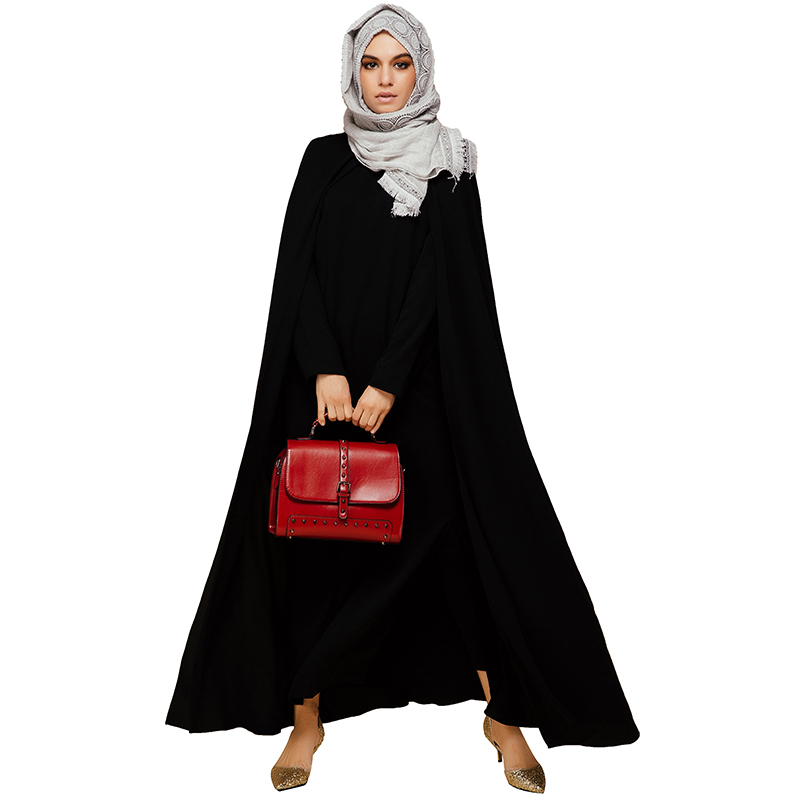
This fall, I am seeing a new trend:  black abayas short enough to show off the designer shoes many women wear here.  I would have loved to overhear the conversations between mothers and daughters during the back-to-school shopping.  Mom:  "That's too short!"  Daughter:  "Mom, nooooo!  You can only see my shoes!"  I'm sure it sounded like the conversations I had with my Mom about how short my skirt could be during the '70s Twiggy fashion era. 


I asked my students this week if I was right in noticing that they are pushing one aspect of the abaya (its length) while preserving a traditional aspect of it (the black color).  Yes, they agreed.  Change comes in one increment at a time.  

For more images of this elegant and diverse piece of clothing, see here

terça-feira, 23 de maio de 2017

ADR in the Arab Gulf


The Future is so Bright, We Will have to Wear Shades


One panel speaker, Assistant Professor Andrew Dahdal, had this to say about last week's ADR conference sponsored by Qatar University College of Law:   
The conference was insightful in many respects. Given that some of my recent research has been looking at the relationship between financial centres and broader national jurisdictions, the discussion concerning the enforcement or arbitral awards in the Dubai International Financial Centre (DIFC) was especially interesting.

The conference -- entitled, The Future of Alternative Dispute Resolution -- A Qatari Perspective -- brought together lawyers, scholars, and ADR neutrals to discuss ADR in the Arab Gulf and MENA regions.  Most of the presentations focused on arbitration, which remains the dominant (and nearly exclusive) form of ADR in the region.

The agenda included opening and keynote speeches by:

  • Dr. Mohammed Abdulaziz Al-Khulaifi, Dean of Qatar University College of Law.
  • Lord Nicholas Phillips, President of Qatar International Court and Dispute Resolution Center (QICDRC).
  • Sultan Al-Abdulla, Managing Partner of Sultan Al-Abdulla & Partners, a sponsor of the event.
  • Prof. Bridgette Stern, Emeritus Professor of International Law at the University of Paris,I, Pantheon-Sorbonne.
  • Dr. Talal Al-Emadi, Chair of the Advisory Board of the QU College of Law Center of Law and Development (CLD).
  • Prof. Mohamed S. Abdel Wahab, Chair of Private International Law and Professor of Dispute Resolution at Cairo University.


The conference also consisted of four panel presentations.  Topics included:
  • Alternative Means for Resolving Economic Disputes.
  • Arbitrating Natural Resources Disputes: Current and Future Trends.
  • Arbitration in Intellectual Property Disputes.
  • Conciliation versus Court Ruling -- Management of Chances and Risks.
  • The Role of Civil and Commercial Court of Qatar Financial Center (QFC) Consumer Dispute Resolution Scheme.
  • Alternative Dispute Resolution in Contemporary Times.
  • Future Challenges and Paradigmatic Changes in International Arbitration: A View from Behind the Curtain.
  • Effect of Minority Not Signing Arbitration Award on the Validity of Arbitral Award.
  • New [Qatar] Arbitration Law no. 2 of 2017: Pros and Cons.
  • Arbitration and Criminal Law: The View from Qatar and UAE.
  • Alternative Methods for Resolving Administrative Contract Disputes in Qatar.
  • The Rise and Fall of International Administrative Arbitration: A Revision on the Commerciality of International Arbitration under Egyptian Law.
  • Enforcement of Arbitral Awards.
Several of my QU College of Law colleagues covered these topics, along with representatives of QICDRC and regional lawyers.

I hope that my colleagues create more opportunities to discuss ADR in the region.  As my own research is beginning to reveal, ADR is still in the early stages of institutional development in the Arab Gulf region.  I also hope that the papers presented at the conference get published in a symposium issue of a law journal. 

I have encouraged the conference organizers to create a webpage where people can access conference slides.  I'd hate to see this material go unrecognized in the future. 

domingo, 21 de maio de 2017

Week 13: Pansies Versus Crocodiles


The Semester Comes to a Close


I had hoped to post a blog every week of the semester about my experience teaching Legal Research & Writing 1 to my Arab students.  But, the semester gets so intense about Week 10 that I feel happy just to keep up with class prep and grading.  


Over the past two weeks, I have conducted individual conferences with students. We look at their attendance record, the point scores on their assessments, their current ranking in the course, and the chance they have for a higher letter grade.  I then review their written work. 

My female students met with me first.  All of them have been working hard this semester. They are dedicated to their studies and show it by good attendance, preparation for class, and a level of engagement that still surprises me.  After all, we meet from 3 to 4:45 p.m. at the end of a very long day.  


I told them that coming to class is like looking out on the sunny, eager, upturned faces of pansies in a flower garden.  I just love them to pieces.  Now that we know each other better, I see their humor, their struggles in balancing home, careers, and children, and their desire to get a good education with a good GPA. 

Then I met with my male students.  That experience is much different.  After a two-hour class, I feel like I have been "wrestling crocodiles."  Their needs are greater, because they are less prepared for the course.


Most of my male students have several children, jobs or businesses, parents who need help, and then a full course schedule. Their attendance for a 9:30 a.m. course is more inconsistent. I need to set more boundaries with them.  I am strict about enforcing course rules. I police more cheating. And, I find myself in more futile negotiations over assessment scores (futile for them). 


Despite being strict with them, I am impressed by their open hearts, good humor, and strong desire to complete the course.

I have about eight male students who show me every class just how smart they are.  One student has perfect attendance and almost perfect scores on the assessments.  They consistently use my office hours to work on their memos. They ask good questions. They help me communicate with my weaker students who struggle because they have poor English language skills.   I am very thankful to them.

We are all exhausted.  My patience runs thin. I need more sleep.  But, all that is true for my students, too. 

I keep telling them:  "I will get you through the semester!"  I keep telling them, as I did the first week of class, that my job is to get them ready for Legal Writing 2.  Most of them are ready.  For the struggling students, their outcome will depend on how they do on the final exam.  I hope they surprise me. 

segunda-feira, 3 de abril de 2017

Week 8: My Research Methodology


How I Conducted the Research


Acknowledgments:

First, I want to thank Qatar University College of Law and my Dean Dr. Mohammed A. Al-Khulaifi for their generous support of this research. I also appreciate the help of Dr. Yasser Khalaileh, Associate Dean for Academic Affairs, Dr. Faouzi Ahmed Belknani, Associate Dean of Research, Dr. Yassin El Shazly, Associate Dean of Outreach and Engagement, and Dr. Conrad Sturm. Finally, I want to thank the many faculty and ADR colleagues who gave me the opportunity to interview them. They generously gave of their time.

The Interviews:

The report reflects about 20 hours of interviews, including the interviews of several QU professors, ADR professionals, law firm attorneys, government attorneys, and a judge sitting on the Qatar International Court and Dispute Resolution Center (QICDRC). At this point in the process, I have interviewed people who live and work in Qatar, but I have also interviewed two people living in Dubai.

I conducted interviews over a three-month period during January to March 2017.

 
All of the interviews took at least an hour. About half the interviews lasted longer than that allotted time.

The Interview Questions:

I adopted interview questions based on an Appreciative Inquiry approach, as I explained in the instructions to interviewees.

In creating the questions, I relied on two resources:

  • Jane Magruder Watkins, et al., Appreciative Inquiry: Change at the Speed of Imagination (2d ed. 2011), and
  • Bernard J. Mohr & Jane Magruder Watkins, The Essentials of Appreciative Inquiry: A Roadmap for Creating Positive Futures (2002).

In this initial round of interviews, I was Beta-testing the questions. While I intend to make a few changes to them, overall, they worked to elicit the information I wanted to collect.

The Initial Report:

During each interview, I took at least seven pages of notes. I then collected those responses in a report.

Accordingly, the report reflects two stages of filtration: First, during the notetaking phase of the interview, and then during my transfer of those notes to the framework of the summary.

I apologize in advance if I failed to capture thoughts or comments of the interviewees accurately.

I then identified themes coming out of the interviews and captured some of my favorite comments or quotes. I will talk about those themes in my next post.

Plans:

I intend to do another 40 hours of interviews. I will expand the geographic scope of the interviews to the UAE, Bahrain, Kuwait, Oman, and Saudi Arabia (i.e. other GCC countries).

As I do more interviews, I will continue to update and revise the report.

I plan to convert the report to a law review article that I will submit for publication during the Fall 2017 publication cycle in the U.S.

I also will present the results of this research at The "2d International Conference on Non-Adversarial Justice" held by the Australian Institute of Judicial Administration beginning April 6-9, 2017 in Sydney, Australia.

I also plan to do more quantitative research by using on-line surveys that will determine the background, training, and experience of neutrals in the Arab Gulf region. I will also ask about the number of disputes the neutrals have handled and which ADR processes they used. The surveys will also explore how often stakeholders are using ADR to resolve disputes and which processes they prefer.

I deeply enjoyed the opportunity to talk with people in the Arab Gulf ADR community. I want to thank them again for their time and energy. I learned so much from all of them and their comments have identified other lines of research for me.

I hope the report provides insight and guidance for the community as it plans its future.

I look forward to serving that community as it continues to expand.

Week 8: I'm Off to Australia for an ADR Conference!


Scaling Up. 
Working at an International Level

When I decided to move to Qatar, I had hoped to scale up my ADR teaching, training, and practice.  In the U.S., I held the state-wide leadership positions in the Virginia Mediation Network and positions on Virginia Supreme Court-sponsored mediation ethics committees and grievance boards.  I loved those opportunities to serve my community.  

However, because of the financial constraints of my law school, I could not actively participate at a national level in leadership of the Section of Dispute Resolution of the ABA or of the Association for Conflict Resolution. Towards the end of my stay in the U.S., my law school was not even funding my attendance at the annual conferences of these organizations. 

By moving to Qatar and joining the faculty of a well-funded university, I hoped to grow professionally and scale up to a more international ADR practice.  


I was lucky, in hindsight, to leap-frog national level participation when too many barriers existed to my greater involvement.  

So, I am excited to participate in my first international ADR conference on a continent I've always wanted to visit.  The conference is entitled: the "2d International Conference on Non-Adversarial Justice," sponsored by the Australian Institute of Judicial Administration.

I will be speaking on the this topic: "Barriers to ADR in the Arabian Gulf: A Conversation About Training, Capacity, and Culture."  I will be joined by 75 speakers over the three-day event. 

In my next few blogs, I will share some of the research that I will presenting at the conference. 

terça-feira, 28 de março de 2017

Week 7: Mid-Term Exams Required Some Flexibility on My Part


Best-Laid Plans 
of Mice and Men . . . .

This week, I had planned to take students through a second CREAC exercise to get them ready for the CREAC Test later in the week.

I wrote a new exercise that was more similar to the problem the students would analyze on the test.  They would apply Qatari trade name and trademark law to two restaurants using a very similar trade name: "The Oryx Diner" and "The Oryx Diner on-the-Go."  


At the beginning of the week, I ran through about 50 of the slides I had prepared. Before you gasp in horror, please know that 50 percent of each slide is a photo or other image.  I still had about 20 more slides to discuss before students would feel more confident about the CREAC Test.

In the meantime, many of the students had four or more exams this week.  They were feeling overwhelmed, over-worked, and a little hopeless.  

Because of some scheduling issues, students in my afternoon class had exams scheduled during my class! So, they were missing the test prep I was providing. Then, I learned that half of them had another exam scheduled the same day I planned to give my CREAC Test.

At that point, I surrendered to the situation.  I offered both male and female students the opportunity to take the test next week when their mid-term exam schedule begins to quiet. 

The relief they expressed almost had a tangible quality to it.  If I had made the announcement in a Facebook video, you would have seen those images of a thumbs up and hearts floating across the page.  I had made myself their hero.


As an ADR expert, I was mindful that I had my own interests at stake.  I needed to give students a chance to integrate the lessons and apply them in some homework before the CREAC Test.  I wanted their first drafts of their first CREAC to be reasonably successful.  It makes my life a lot easier during the second half of the semester. 

Not only that, I really did not want to grade a bunch of exams right before I took off for my trip to Australia for an ADR conference.

In short, I met many non-competing interests in postponing the exam.  Win-win, blah, blah, blah . . . .
Related Posts Plugin for WordPress, Blogger...