sexta-feira, 9 de maio de 2014

Bird Deaths at Wind Farms (Part 1)


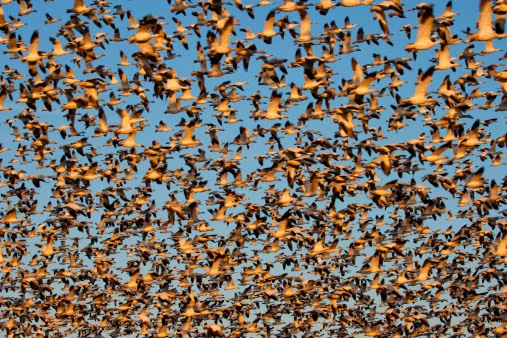
Growth of Farms Puts More Birds At Risk


Introduction

A 2008 Department of Energy report calls for the U.S. to generate 20% of its electricity from wind by 2030. By then, experts expect wind turbines to kill at least one million birds each year, and probably significantly more, depending on how many turbines developers build over that time. Wind farms are also expected to impact almost 20,000 square miles of terrestrial habitat, and over 4,000 square miles of marine habitat by 2030, some critical to threatened species.

Deaths will come to birds who hold our identity and imagination, like Bald Eagles and other raptors. Turbines also kill birds listed as threatened or endangered unless developers carefully plan and implement wind farms. Onshore, these species include Golden Eagles, Whooping Cranes, sage-grouse, prairie-chickens, and many migratory songbirds. Offshore, species at risk include Brown Pelicans, Northern Gannets, sea ducks, loons, and terns, among other birds.

Scientists poorly understand the relationship of current fatalities to the demographics of bird and bat populations, but some experts do not see a problematic link between current wind farm fatalities and declines in bird populations (NAS 2007). My earlier post shows that other man-made structures cause far more bird deaths.  Domestic and feral cats pose the greatest risk to bird populations.

However, as wind energy facilities increase in number, fatalities and thus the potential for biologically-significant impacts to local populations increases (NAS 2007; Erickson et al. 2002; Manville 2009).


Mechanics of Wind Turbines

Early turbines were mounted on towers 60–80 feet in height with rotors extending 50–60 feet in diameter. The blades turned 60–80 revolutions per minute (rpm).
Today's land-based wind turbines are mounted on towers 200–260 feet in height with rotors 150–260 feet in diameter. The blade tips reach over 425 feet above ground level. Rotor swept areas now exceed 1 acre. Engineers expect the reach of the blade sweep to cover nearly 1.5 acres within the next several years. 

Under the current design, the speed of rotor revolution has significantly decreased to 11–28 rpm, but blade tip speeds have remained about the same. Under normal operating conditions, blade tip speeds range from 138–182 mph. 

For some disturbing video about bird deaths at wind farms, see here (Altamont Pass) and here (bird strike).

Wider and longer blades produce greater vortices and turbulence in their wake as they rotate, posing a potential problem for bats and small songbirds.

Engineers have reduced the number of turbines needed to produce a megawatt of electrical power by increasing the efficiency of each turbine. Accordingly, developers can generate power equivalent to older farms using fewer turbines that are more widely spaced. 

Still, Manufacturers are developing larger turbines.The one pictured here seems to be large enough for a helicopter landing pad and is destined for offshore use. 

The Research

In future posts, I'll discuss the current research on bird deaths at wind farms. Scientists/industry have conducted five major studies to date:
  • 2013 Smallwood Study: 573,000 bird deaths per year.
  • 2013 Canadian Bird Mortality Study: 233,000 bird deaths per year, and habitat displacement of 57,000 breeding pairs.
  • 2009 U.S. Fish & Wildlife Service Study: 440,000 per year.
  • 2013 Smithsonian-Sponsored Study: 140,000 to 328,000 per year (limited to monopole turbines).
  • Wind Industry Estimate: 58,000 per year.

    domingo, 4 de maio de 2014

    Our Tolerance for Bird Deaths at Energy Facilities


    Significant Losses at Power Plants 
    and Transmission Lines


    Bird Populations Slumping:

    Since the release of bird status reports at the Asilomar Conference, bird populations have continued to slump, and the list of North American birds with declining populations or otherwise at risk at the regional and continental levels has increased since 2002 where 131 species were then designated (USFWS 2002). 

    Today, these include 147 species on the 2008 Birds of Conservation Concern list (USFWS 2008), 92 birds federally listed as Threatened or Endangered on the Endangered Species Act (ESA), State-listed species, and species listed as high priorities on the U.S. Shorebird Conservation Plan, among others. 

    The growing documented and suspected impacts of structures on birds—from direct collision mortality, barotrauma, electrocutions, cumulative effects, and from habitat fragmentation, disturbance and site avoidance—bode poorly for our bird populations.


    Migratory birds—of which there are currently 836 designated species—are a Federal trust resource managed and protected by the U.S. Fish and Wildlife Service (USFWS). The published list of the 836 species is found at 50 CFR Ch. 1, 10.13, List of Migratory Birds.*


    Reasons for Bird Deaths:

    The estimated cumulative impact of collisions with wind turbines is several orders of magnitude lower than the estimated impacts from the leading anthropogenic causes of bird mortality.

    The available data estimates the following causes of death (in millions per year) for birds:


    • Aircraft .08
    • Wind turbines .58 to.573
    • Large communication towers 6.8
    • Power plants 14.33
    • Cellular, radio & microwave towers 4 to 50
    • Cars and trucks 50 to 100
    • Agriculture 67
    • Pesticides 72
    • Building windows 97 to 976
    • Hunting 100
    • Transmission lines 175
    • Domestic and feral cats 210 to 3,700

    Thus, the biggest threat to birds are cats that live some part of the day outside where they hunt and kill birds.  They kill up to 3.7 billion birds per year.


    This data also reveals our tolerance for bird deaths associated with energy-related projects, including power plants, and transmission lines.  Deaths at either of these types of facilities far exceed deaths at wind farms.
    Bird Deaths and Wind Farms:
    Still, we may want to answer the questions:  
    • How many more cumulative bird deaths do we want to tolerate at wind farms projects?
    • Are wind farms especially dangerous to specific species of birds that we have a heightened need to protect, like eagles?
    • Can wind farm operators design wind farms to mitigate bird deaths?
    • Can they monitor and operate wind farms to mitigate bird deaths?
    I will answer these questions in future posts in this series. 
    * This discussion is derived from sources I researched in connection with the Environmental Dispute Resolution course I teach.  I am not including citations to those sources, and I acknowledge that some of this discussion is directly lifted from those sources (with my apologies to the authors I failed to credit).  Eventually, I plan to write a law review article on this topic and the original sources will receive credit there.    

    sábado, 3 de maio de 2014

    Wind Power and Eagles on Collision Course


    American Bird Conservancy Will Sue the U.S. Department of Interior 

    In a news release issued yesterday,  Washington, D.C.-based American Bird Conservancy (ABC) has announced its intention to sue the U.S. Department of the Interior (DOI).

    [They explain that they plan] to charg[e] the agency with multiple violations of federal law in connection with its recent decision to offer wind energy companies and others to obtain 30-year eagle take permits. The previous rule provided for a maximum duration of five years for each permit, which authorizes projects to "take" (i.e., injure, kill or otherwise disturb) eagles.
    On April 30, ABC sent the DOI and the U.S. Fish and Wildlife Service (FWS) a notice of intent to sue, and the group has chosen public interest law firm Meyer Glitzenstein & Crystal to represent it. ABC argues that the new eagle take rule violates the National Environmental Policy Act (NEPA), the Endangered Species Act (ESA), and the Bald and Golden Eagle Protection Act (BGEPA).

    ABC says it is initiating legal action in order to have the rule invalidated pending full compliance with federal environmental statutes. For example, the group charges that the 30-year eagle permit rule was adopted in the absence of any NEPA document or any ESA consultation regarding impacts. It is, therefore, a “glaring example of an agency action that gambles recklessly with the fate of the nation’s bald and golden eagle populations,” the letter says.
    On December 6, 2013, the DOI announced that it planned to change the rule governing eagle "takings."   It explained:
    In 2009, the Service began a permitting program under the Bald and Golden Eagle Protection Act applicable to developers of renewable energy projects and other activities that may “take” (injure, kill or otherwise disturb) bald and golden eagles. The Eagle Act allows the Service to authorize the programmatic take of eagles, which is take associated with, but not the purpose of, an otherwise lawful activity and does not have a long-term impact on the population. 
    These permits have been for a maximum of five years – a period that does not reflect the actual operating parameters of most renewable energy projects or other similar long term project operations. The revised rule, a result of extensive stakeholder engagement and public comment, extends the maximum permit tenure to 30 years, subject to a recurring five-year review process throughout the permit life.

    Only applicants who commit to adaptive management measures to ensure the preservation of eagles will be considered for permits with terms longer than five years. Any such increased measures, which would be implemented if monitoring shows that initial permit conditions do not provide sufficient protection, will be negotiated with the permittee and specified in the terms and conditions of the permit.
    All permits will be closely monitored to ensure that allowable take numbers are not exceeded and that conservation measures are in place and effective over the life of the permit. Steps taken today will increase transparency and accountability by making annual reports and five-year compilations of eagle fatalities available to the public.

    The revised regulations also increase the fees charged for processing programmatic permit applications to reflect the true cost to the Service of developing adaptive conservation measures and monitoring the effectiveness of the terms and conditions of the permits. Permits also will now be transferable to new owners of projects, provided that any successor is qualified and committed to carrying out the conditions of the permit. For more information, click here.
    * * *  
    [T]he Service solicited public comments about the permit program concerning a number of specific issues, including:
    • How the Eagle Act’s language regarding preservation of eagles should be interpreted and applied;
    • The level of impacts that trigger compensatory mitigation;
    • Issuance criteria for programmatic permits; and
    • Possible mechanisms for streamlining permits.
    The Service will solicit additional public input on the 2009 permit regulations at a series of regional workshops that will take place in early 2014, along with an opportunity to submit written comments. The Service anticipates publishing a proposed rule and accompanying NEPA documents in fall of 2014, with a final rule and NEPA documents in fall of 2015.
    The final rule is available here.
    In my Environmental Dispute Resolution course, we spent a 2-hour class period discussing the impact of wind farms on raptors and other bird species.  In my next blog post, I'll share what we learned.

    quarta-feira, 30 de abril de 2014

    First Fracking Verdict in U.S. History


    Plaintiff Awarded $2.9 Million:  Post-Trail Motions and Appeal Certain
    Charles Sartran of the Energy & the Law blog discusses what is being characterized as the "first fracking verdict in U.S. History." 
    Background: 
    [A] Texas jury awarded $2.9 million to landowners in a case involving alleged hydrocarbon exposure due to hydraulic fracturing operations. Here is the jury verdict. The Parrs sued Aruba Petroleum, alleging that drilling and frac[k]ing at Aruba’s 22 wells located within two miles of the Parr’s 40-acre property in Wise County was making them sick. They alleged a wide array of health issues, including nose bleeds, irregular heartbeat, muscle spasms, and open sores, all of which were allegedly caused by hazardous gases and airborne chemicals emanating from Aruba’s well sites.
    Outcome:
    The case proceeded to the jury only on the nuisance claim. The award, for intentionally creating a private nuisance, comprised $275,000 for loss in property value, $2 million for past pain and suffering, $250,000 for future pain and suffering, and $400,000 for past mental anguish. The jury did not find evidence of the malice necessary to justify an award of punitive damages.

    In my Environmental Dispute Resolution course, we spend a 2-hour class period discussing fracking, as well as the power landowners gain against developers when they collaborate in the negotiation for shale gas recovery.  

    The fracking process is explained in this industry video.

    Several videos on YouTube describe the risks of the fracking process to adjacent landowners and aquifers.  I found them compelling, but I admit that I have not spent enough time in the industry to developed an informed opinion.  Links to the videos are herehere, here, here, here, and here.  You can also find industry dismissal of the risks here.

    My concern is that production outpaces what we know about the long-term risks to human health.  

    May 1, 2014 Update:  New York Times op-ed piece discussing pros and cons of shale gas development here.  Authors Michael Bloomberg and Fed Krupp argue:
    Strong rules and enforcement are critical. And, as one of us, Fred Krupp, describes in the current issue of Foreign Affairs, states are beginning to take action. Texas has imposed tough standards for well integrity, a key to groundwater protection. Wyoming has set strong requirements for water testing before drilling begins. Ohio is emerging as a leader in reducing air pollution from leaky oil and gas equipment. And in February, Colorado became the first state to directly regulate methane emissions from oil and gas operations — a huge step forward.

    domingo, 27 de abril de 2014

    ADR and the BP Gulf Claims Facility


    Using ADR to Compensate Victims of Environmental Catastrophes


    In my Environmental Dispute Resolution course, I devote one class to a discussion of the claims facilities used in the 9/11 terrorist attacks and the BP Gulf Coast oil spill disaster.  The facilities attempted to handle the inevitable claims arising from these traumatic events in an organized way that allowed expeditious handling of the claims outside of litigation.  Both adopted a form of arbitration.  

    If well designed, these facilities could also enhance procedural justice for claimants --  voice, careful consideration of the facts by the neutral, impartiality by the neutral, and respectful and dignified treatment of claimants.

    Updating the Story

    An article in The New York Times today updates the status of the Gulf Coast claims facility.    

    The Times describes the spill this way:
    The oil rig fire and the nearly unstoppable fountain of oil that followed at the Macondo Prospect on April 20, 2010, was the largest marine oil spill in the nation’s history. The oil poured into the gulf for 87 days, fouling an estimated 68,000 square miles of waters and almost 500 miles of coastline from Louisiana to Florida.
    The spill released approximately 210 million gallons of oil.

    BP, its reputation damaged and facing administrative penalties, criminal prosecution, and vast class action lawsuits, agreed to create a process designed to handle the civil claims for damages. With time, the agreement governing the Gulf Coast claims facility morphed into a 1,000-page document entitled the 2179 Economic and Property Damage Class Action Settlement Agreement.  

    BP's Buyer's Remorse

    Increasingly, BP has had buyer's remorse as the tab for the civil liability associated with the spill has grown from a predicted payout of  $7 billion to an estimated pay-out of $ 19.5 billion.  The Times explains:
    A central element of the agreement . . . would prove to be a time bomb. Instead of having claims calculators contend with different kinds of arguable evidence to prove that damage was linked to the spill, the negotiators came up with a formula that relied solely on financial data for proof of harm. If a business was in a certain region and could prove that its income dropped and rose again in a specific pattern during 2010, that would be enough to establish a claim.
    This liberal test has brought a "frenzy" of claims.  

    BP has unsuccessfully challenged in federal court the administrator's interpretation of the agreement.  Its lawyers also sought greater oversight of possible fraud in the claims handling process.  The supervising judge called in Freeh Group, a firm headed by Louis J. Freeh, the former F.B.I. director, to investigate. Freeh issued a 98-page report finding some problems, but not a vast system of corruption.  More recently, BP began appealing one in five claims awards under the appeals provisions of the settlement agreement.

    ADR Expert Expresses Dismay

    Kenneth Feinberg, who spoke to our students last year, served as the administrator of the 9/11 Victims Compensation Fund and as the first administrator of the Gulf Coast claims facility. 

    The Times quotes him expressing "dismay" that the problems associated with the Gulf Coast claims facility “too easily lead[] to the conclusion that an alternative resolution doesn’t work, and in an oil spill you’re better off with an Exxon-Valdez, decades-of-litigation approach. That’s a real public policy missed opportunity.”

    Exxon Valdez Spill

    Feinberg references the March 24, 1989 accident in which the Exxon Valdez ran aground, tore its hull, and spilled 11 million gallons of oil into the Alaska's Prince William Sound. Until the BP spill, the Exxon Valdez accident was seen as the biggest environmental disaster in U.S. history. 

    In 1989, only a few law schools were beginning teach ADR principles, skills, and values, most notably the University of Missouri Law School under the leadership of Len Riskin.  

    Accordingly, the court adopted the best known approach to mass torts. It approved a class consisting of 32,000 fishermen, Alaska natives, landowners, and others whose livelihoods were gravely affected by the disaster. Lawyers for this class have explained the history of the litigation:
    • A class action jury trial was held in federal court in 1994. The jury returned an award of $5 billion in punitive damages. 
    • In 2001, the Ninth Circuit Court of Appeals ruled that the original $5 billion punitive damages verdict was excessive. 
    • In 2002, U.S. District Court Judge H. Russell Holland reinstated the award at $4 billion. Judge Holland stated that, “Exxon officials knew that carrying huge volumes of crude oil through Prince William Sound was a dangerous business, yet they knowingly permitted a relapsed alcoholic to direct the operation of the Exxon Valdez through Prince William Sound.” 
    • In 2003, the Ninth Circuit again directed Judge Holland to reconsider the punitive damages award under United States Supreme Court punitive damages guidelines. 
    • In January 2004, Judge Holland issued his order finding that Supreme Court authority did not change the Court’s earlier analysis. 
    • In December 2006, the Ninth Circuit Court of Appeals issued its ruling, setting the punitive damages award at $2.5 billion. 
    • Subsequently, [in 2008,] the U.S. Supreme Court further reduced the punitive damages award to $507.5 million, an amount equal to the compensatory damages. With interest, the total award to the plaintiff class was $1.515 billion.
    In short, class action claimants waited over 20 years to reach this litigated resolution.  One environmental organization called it a "historic legal battle." 

    Most of my students would have been toddlers when the accident happened. 

    So, back to my first paragraph.  These claims facilities must be well-designed.  The Gulf Coast claims facility will offer new lessons for future designers about when this alternative approach makes sense.

    So far, the federal courts have backed the process and shown overall confidence in the current administrator, Patrick Juneau.   

    May 9, 2014 Update: More on BP's challenges of certain claims here

    sexta-feira, 25 de abril de 2014

    Stories of Success Among Grads of Lower Ranked Schools


    Some Balance to the Gloom and Doom Stories

    Brian Leiter, ABA Top 100 Blawger, has shared a conversation among graduates of lower tiered schools here. The conversation started with this question:

    cheapbrass (Apr 18, 2014 - 2:53 pm)
    If you are a tier 2 or below grad...and are somewhat successful ($100k+ salary) post here. how far out of school you are and your firm size, or if you are a solo, partner, or associate. Me first: Tier 3, 10+ years out, firm size 5-10, forever associate.
    The comments, largely stories of success, mirror the stories I hear from most of the alumni of ASL.  

    If you have your own stories of success, feel free to post them in the comments to this blog.   

    quarta-feira, 23 de abril de 2014

    Trust: Breach and Repair


    Trust: Breach and Repair
    The Nature of Trust

    Three elements contribute to the level of trust one has for another:
    • The individual’s chronic disposition towards trusting others;
    • Situational parameters; and
    • The history of their relationship. 
    Two general categories of trust exist:
    • Calculus-based trust: Grounded in the fear of punishment for violating trust and in the rewards to be derived from preserving it.

    • Identification-based trust:  Based on the identification with the other person’s desires, goals, and intentions.  It exists because the parties can effectively understand and appreciate one another’s wants. 
    Rebuilding Trust:

    Re-establishing trust, once breached, is very difficult.  

    “In conflict, trust is broken, cruel words are spoken, friendships dissolve, love turns to hate, and hate into revenge.” 


    “Trust is rebuilt not by focusing on what the other person did or did not do, but on improving one’s own behaviors, increasing one’s trustworthiness, and being congruent – not just in words and promises, but in actions, attitudes, and character.  It depends on integrity and authenticity.”

    Former adversaries can rebuild trust by:
    • Treating each other with unconditional respect.
    • Listening deeply and sincerely, especially to criticism.
    • Expressing empathy for the other person, even if the other party does not listen or empathize in return.
    • Speaking openly and honestly about problems and failures, especially one’s own.
    • Being sincere and unlimited with apologies, as with criticisms.
    • Negotiating clear boundaries and respecting those established by others, even when others do not respect them in return.
    • Supporting participation and teamwork, empowering others, and making decisions collaboratively.
    • Agreeing on vision, shared values, and goals, and acting on them.
    • Acknowledging interests and being flexible regarding solutions.
    • Being willing to sacrifice something important to aid a former opponent or to achieve a higher goal.
    • Participating in social interactions and sharing information about each other’s personal lives.
    • Being consistent and dependable in crisis and hard times.
    These recommendations are easier to list than to implement.  Yet, doing so leads to personal growth and learning.  

    And, even if your opponent continues to distrust you, by adopting these behaviors you can restore balance into your own life centered in positive intention, and even love, but certainly respect for yourself and for others.  

    April 29, 2014 Update:  The blogger at The Legal Watercooler provides an interesting discussion of trust breach and repair through the lens of the show Mad Men.  I just started the sixth season on Netflix last night.  So, I am watching Don Draper's acts of breach of trust. I'm anxious now to learn how he goes about repairing that trust.  
    Related Posts Plugin for WordPress, Blogger...