Mostrar mensagens com a etiqueta student organizations. Mostrar todas as mensagens

domingo, 26 de outubro de 2014

ASL Lion's Club Shrimp Boil and Corn Hole Tournement


A Touch of New Orleans 
and 
the Kentucky Derby Melded for a Charitable Cause

Several years ago, our Dean, Lucy McGough, joined us after having lived in Baton Rouge, Louisiana most of her academic career.  Soon, events linked to that history came to campus. First, came the sale of home-made gumbo to raise funds for a local charity.  Then, ASL had its first shrimp boil.  


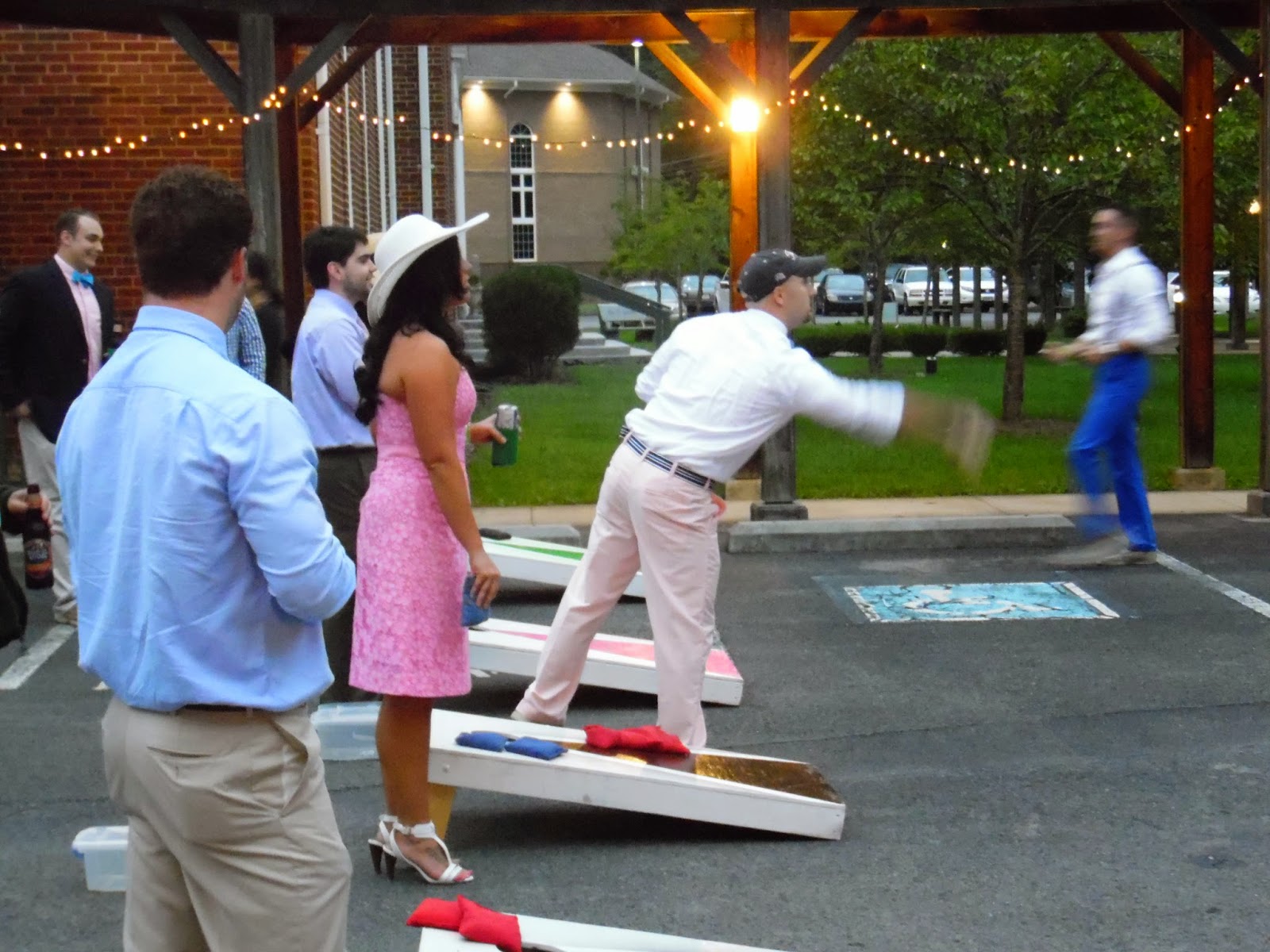
Last month, the local chapter of the Lion's Club sponsored  the second shrimp boil on campus along with a corn hole tournament designed to raise money for its many worthwhile projects.  The local organization especially focuses on the needs of the low-income residents of Buchanan County who need eye exams and eyeglasses.  


I profiled the Lion's Club as a student organization here.


Students and faculty at ASL enjoyed a meal of spicy shrimp, sausages, corn, and potatoes. Many of the students participated in the corn hole tournament.  Josh Kinzer, the President of the Grundy Chapter of the Lions Clubs International, explained that the event raised awareness about Lion's Club projects. 

Micah Bailey, an ASL 3L student, brought his lovely wife and son. He said: "It was a great opportunity to meet other students and mingle with the faculty members.  The turnout was amazing, and we could not be more pleased with the student body participation." 


In a small town like Grundy, students quickly learn how they can create their own fun while serving the community through many community service projects. I blogged about ASL's award-winning community service program here.


Love you all so much!  You are lovely and big-hearted.

quinta-feira, 4 de setembro de 2014

ASL Student Organizations

Opportunities to Serve the School, the Community, and the Profession


This week, we held a bar-b-que that gave student organizations an opportunity to recruit members.  

I profiled all, or nearly all, of ASL's student organizations in a series of posts beginning in August 31, 2013 that continued through October 2013.

They are:

Pro Bono Legal Service Providers:
  • Court Appointed Special Advocates (CASA
  • VITA Tax Services (VITA
  • Great Eastern Trail Project (GET
Law Journals:
  • Appalachian Journal of Law (AJoL)
  • Appalachian Natural Resources Law Journal (ANRLJ)
Student Government:
Legal Fraternities:
  • Blackwell Inn Phi Delta Phi (PDP
  • Phi Alpha Delta Law Fraternity, International (PAD
Focus on Substantive Law:
  • ADR Society 
  • Criminal Law Society (CLS
  • Education Law Society (ELS
  • Energy and Mineral Law Society (EMLS
  • Environmental Law Society (ELS
  • Innocence Project 
  • International Law Society (ILS
  • Patent Law Association (PLA
  • Sports & Entertainment Law Society (SELS
  • Sutin Public-Interest Association (SPIA
Affinity Groups:
  • Appalachian Women in the Law (AWIL
  • Black Law Students Association (BLSA
  • Christian Legal Society (CLS
  • Gay/Straight Legal Association (GSLA or Outlaw) 
  • Hamilton Society (veterans)
Political Viewpoints:
  • Democratic Law Society (DLS
  • Republican Law Society (RLS
  • Federalist Society (conservatives/libertarians) 
  • American Constitution Society (ACS
Geographic Groups:
Sports Groups:
Other Groups: 
For more information about these student organizations, take a look at the late August, September, and early October 2013 postings at The Red Velvet Lawyerhttp://the-red-velvet-lawyer.blogspot.com.  Keep in mind that some of the listed officers have changed.  

For information about funding or creating an organization, see here and here

quinta-feira, 17 de outubro de 2013

The List of ASL Student Organizations


Student Organizations at the 
Appalachian School of Law

So here it is -- after more than a month of research -- the list of student organizations operating at the Appalachian School of Law.  I am proud of the programming and service our students provide our law school and the regional community.  These organizations enhance our well-being in so many ways.  

Pro Bono Legal Service Providers:
  • Court Appointed Special Advocates (CASA) 
  • VITA Tax Services (VITA) 
  • Great Eastern Trail Project (GET) 
Law Journals:
  • Appalachian Journal of Law (AJoL)
  • Appalachian Natural Resources Law Journal (ANRLJ)
Student Government:
  • Student Bar Association (SBA)
  • Honor Court
Legal Fraternities:
  • Blackwell Inn Phi Delta Phi (PDP) 
  • Phi Alpha Delta Law Fraternity, International (PAD) 
Focus on Substantive Law:
  • ADR Society 
  • Criminal Law Society (CLS) 
  • Education Law Society (ELS) 
  • Energy and Mineral Law Society (EMLS) 
  • Environmental Law Society (ELS) 
  • Innocence Project 
  • International Law Society (ILS) 
  • Patent Law Association (PLA) 
  • Sports & Entertainment Law Society (SELS) 
  • Sutin Public-Interest Association (SPIA) 
Affinity Groups:
  • Appalachian Women in the Law (AWIL) 
  • Black Law Students Association (BLSA) 
  • Christian Legal Society (CLS) 
  • Gay/Straight Legal Association (GSLA or Outlaw) 
  • Hamilton Society (veterans)
Political Viewpoints:
  • Democratic Law Society (DLS) 
  • Republican Law Society (RLS) 
  • Federalist Society (conservatives/libertarians) 
  • American Constitution Society (ACS) 
Geographic Groups:
  • Beltway Bar Association
  • North Carolina/South Carolina Bar Association
Sports Groups:
  • ASL Softball Team
  • ASL Pistol, Gun & Hunt Club
  • Running Club
Other Groups: 
  • American Association for Justice (AAJ) (trial lawyers) 
  • ASL Cares (for pet adoption and rescue) 
  • ASL Happiness Project (student well-being) 
  • Community Thread Society (for CASA kids) 
  • Lions Club 
  • Jug Band aka Grun-D-MC (musicians) 
  • The Rhetoricals, Toastmasters International (public speaking) 
For more information about these student organizations, take a look at the late August, September, and early October 2013 postings at The Red Velvet Lawyer, http://the-red-velvet-lawyer.blogspot.com.

quarta-feira, 16 de outubro de 2013

Student Bar Association: Funding Student Organization Activities

Funding Student Organization Activities 
at the
Appalachian School of Law 
Rather than paraphrase the rules governing SBA appropriations for student organizations, I am simply reproducing the relevant provisions of the Bylaws of the ASL SBA.
§ 3. Allocation of Student Activity Fees 
I. Preliminary Organization Budget
A. Any student organization or student group seeking funding from the Senate shall submit a proposed itemized budget to the SBA Fiscal Policy Committee (Committee). The proposed budget request shall be submitted to the Committee no later than April 1st of the academic year preceding the academic year in which the funds are to be requested. Full funding is not guaranteed nor should be expected. These proposals do not bind the SBA, nor the organization. 
1. The Committee shall only accept proposals signed by the Organization President, Treasurer, and Advisor, or their equivalents. 
2. All budgets shall remain proposals until the SBA Budget is approved by the Board of Trustees.
3. Final appropriations to organizations shall be considered on an event-by-event basis.
B. Upon SBA Senate approval by a simple majority vote, the SBA Treasurer shall submit the final aggregate SBA budget proposal to the Dean and President of the Law School with the SBA President’s and Faculty Advisor’s signature, in accordance with Law School procedures.
C. After the Board of Trustees has made its decision as to SBA funding, the Committee shall meet again to finalize each organization’s proposed budget. 
D. At the first meeting of the fall semester, the SBA Treasurer shall report to the SBA Senate the final budget the Board of Trustees approved for the academic year. 
E. As soon as the SBA Senate approves the budget provided by the Board of Trustees, the SBA President and Treasurer shall notify each organization as to their approved budget figures.
II. Final Appropriation 
A. Any organization or student group requesting funding must complete an official SBA
Organization Funding Request Form which shall be available on the SBA website. 
B. This form must be submitted to the SBA Treasurer by 5:00 p.m. the Friday before the SBA meeting. 
C. The organization’s request shall be entered into New Business on the agenda and sit “on the table.” No organization member need be present at this meeting. 
D. At the next SBA meeting, the organization’s request is entered as “Old Business.” 
1. A representative from the organization must be present at this meeting to answer questions from the Senate. 
2. If no representative is present at the meeting, the request shall be tabled. 
3. The request shall pass upon a simple majority of the Senate’s votes cast. 
E. The SBA Treasurer shall notify the ASL Business Office of authorized disbursements.
III. Funding Priority 
A. Priority shall be given to those organizations or student groups which have submitted a budget requesting SBA funding in a timely fashion and are otherwise in compliance with the requirements of SBA recognized organizations. Funding shall not be limited to officially recognized organizations. 
B. The Senate may, at its sole discretion, provide funding to newly formed and recognized student organizations, however, no organization or student group which has not submitted a proposed budget as per subpart I of this section shall be guaranteed any funding from the Senate. 
IV. Accounting Procedures 
A. All organizations and student groups receiving funds from the SBA must account for their
spending. Each organization or student group must provide an itemized listing of all vendors and expenses within Fourteen (14) days of the event to the Business Office. A form shall be provided by the SBA Treasurer that organizations or student groups may use to meet this requirement. 
Also, the organization shall return its receipts and invoices to the Business Office within Thirty (30) days after the event. For projects that take place over an extended period of time, the organization shall make arrangements with the Business Office to return the receipts and invoices in a manner that is agreed to by both the SBC and the organization or student group. 
B. At the end of each semester, all organizations shall be required to conduct an audit of the organization’s finances in cooperation with the SBA Treasurer and Head of the ASL Business Office. The Fall audit shall be submitted no later than November 15th. The Spring audit shall be submitted no later than March 1st. 
C. Organizations and student groups that do not comply with this section shall not be placed on any subsequent SBA Senate agenda for any matter until the organization or student group is in compliance. Furthermore, the Senate maintains the authority to reduce an organizations or student groups budget should that Organization fail to comply. Multiple infractions shall constitute grounds for an organization or student group to be properly brought before the Honor Court. 
V. Donation of SBA Funds 
No SBA recognized organization or student group may donate any monies derived in any way from student activity fees previously allocated to the organization or student group without prior approval of the Senate. Any organization or group donating SBA funds shall submit sufficient proof to the SBA Treasurer that the funds were in fact received by the donee. Any such donation shall be made on behalf of the organization and the SBA of the Appalachian School of Law. 
VI. Funding Criteria and Senate Decorum
A. All events funded by the SBA must be open to the entire student body. 
B. Any funding for travel cannot exceed the per diem rate for the destination area set by the ASL. If ASL has not set such a rate, the Internal Revenue Service (IRS) per diem rate shall apply. 
C. Voting members of the SBA can not base their decisions about on funding based on race, religion, creed, national origin, gender, sexual preference, political preference, or ideological preference. 
D. A voting member of the SBC may not vote on a request before the Senate if he/she is an executive officer of that organization or student group requesting funding.

terça-feira, 15 de outubro de 2013

Student Bar Association: Standing Committees of the SBA


Standing Committees of the Student Bar Association (SBA) of the Appalachian School of Law 

The Student Bar Association -- which I have described in a series of postings hereherehere, and here -- has established a number of standing committees.  They are:
  • American Bar Association Representative
  • Student Activity Council
  • New Organization Review Committee
  • Fiscal Policy Committee
  • Charitable Endeavors Committee
  • President's Council
  • Career Services Advisory Committee
  • Legacy Committee
  • Mental Health Committee, and
  • Property Management Committee
Section 5 of the Bylaws of the Appalachian School of Law Student Bar Association describes each of these committees:

American Bar Association Representative
In the Spring semester, the newly elected SBA President shall appoint an American Bar Association (ABA) Representative. The ABA Representative shall be a rising 3L whose primary responsibility will be to represent the school in all activities of the Law Student Division (LSD) of the ABA. 
The primary criteria for appointment that the President shall consider shall include, but is not limited to; the member’s past commitment to representing the Law School at past functions sponsored by the LSD and that SBA member’s past service the SBA and the Appalachian School of Law. 
The ABA Representative shall be responsible for recruiting new members. The ABA Representative shall also coordinate the activities of the SBA within the LSD. The President may assign additional duties to the ABA Representative to assist Officers in performing their constitutional duties. However, any duties that the President may assign the ABA Representative shall not conflict with those responsibilities specifically enumerated in this paragraph or as may be assigned by the ABA/LSD. It shall be within the sole discretion of the ABA Representative whether to accept additional duties.
Student Activity Council
The Student Activity Council shall develop and promote activities beneficial to the Appalachian School of Law community. The committee shall be lead by a Chairperson who shall be appointed in the Spring semester by the new SBA President. The Chairperson may select students to serve as committee members. Additionally, a faculty representative designated by the Chairperson may participate in any meetings of the Student Activity Council. The Student Activity Council shall coordinate the scheduling of planned events with the proper representative of the Law School. 
The Student Activities Council shall be primarily responsible for the following events: Student
lunches and the ASL Pig Roast. The Student Activity Council may organize any additional activities which will contribute to the social or educational atmosphere of the Law School. The Student Activity Council shall submit a written budget request for each event to the Senate for approval.

New Organization Review Committee (NORC)

Described in the posting about creating a student organization found here.

Fiscal Policy Committee
The Fiscal Policy Committee shall be established to prepare an annual SBA budget for submission to the Law School Administration. The Fiscal Policy Committee shall also be responsible for periodically reviewing SBA funding policies and procedures should such a need arise. The Committee shall be chaired by the SBA Treasurer. In addition to the SBA Treasurer, the Committee shall consist of two Senators, a rising 2L and rising 3L, who are appointed in the spring semester by the newly elected President. The Committee shall, after each meeting, prepare a report of its activities to be delivered at the next regularly scheduled meeting of the
Senate.
Charitable Endeavors Committee
The Charitable Endeavors Committee shall be established to develop and promote an annual event to benefit the Blackwell, Dales and Sutin Memorial Funds. The Charitable Endeavors Committee shall be responsible for the following annual events: the Halloween Candy Give Away, the Christmas Angels Program (or some similarly styled program), the SBA Easter Egg Hunt, the Memorial 5K, and any other activities of service to the Law School and local communities. 
The Committee shall be lead by a Chairman appointed in the
spring semester by the newly elected President. Said Chairman may then select students to serve on the Charitable Endeavors Committee.
President’s Council
Periodically the SBA President shall convene a meeting of the Presidents of all SBA recognized organizations. The purpose of these meetings shall be to enhance communication between the organizations individually and the SBA Senators and Officers. Specifically SBA recognized organizations shall be informed of all applicable procedures adopted by the Senate and Law School Administration. The President’s Council shall meet at least twice during each spring and fall semester while the Law School is in session.
Career Services Advisory Committee
The Career Services Advisory Committee shall be established to assist in development and
promotion of student employment opportunities. The Committee shall meet once a month during the academic year with the Career Services Director, who shall serve as the faculty advisor of the Committee, to discuss topics of concern to the students regarding the employment process. The Committee will serve to facilitate communication between the Career Services Office and the students of ASL regarding the employment process. Committee members will assist in scheduling programs for the career services office regarding recruiting, interviewing, internships, judicial clerkships, and professionalism. 
The SBA President shall appoint three (3) 3L students, one of which the President shall appoint Chairperson of the Committee, three (3) 2L students, and two (2) 1L students shall be appointed after November 1 of the current academic year.
Legacy Committee
The Committee shall be responsible for memorializing the events of the year. This includes, but is not limited to; taking pictures at school functions on and off campus, writing articles detailing the events of those functions, and compiling a photo album or yearbook at the end of each academic year. The Committee shall be lead by a Chairperson appointed by the President. Said Chairperson may select students to help serve on the Committee.
Mental Health Committee
The purpose of the Mental Health Committee (MHC) shall be to promote the physical and emotional well being of the students of the SBA and to provide programming to aid students in achieving these goals. Furthermore, pursuant to the American Bar Association Mental Health Initiative this program shall be designed to increase awareness of law student mental health issues and substance abuse problems. 
The MHC shall be lead by a Chairperson appointed during the Spring semester by the newly elected President. The Chairperson shall have the authority to select students to aid the Chairperson in carrying out these goals.
This committee has coordinated activities with the ASL Happiness Project profiled here.

Property Management Committee
The purpose of the Property Management Committee (PMC) shall be to organize, inventory, and store all of the property of the SBA. The PMC shall be responsible for informing students and organizations of the existence of any materials they may need. The PMC shall strive to reduce waste and unnecessary spending of SBA funds. 
The Committee shall be lead by a Chairperson, referred to as the Property Manager, appointed by the President. Said Chairperson may select students to help serve on the Committee.

Student Bar Association: The Legislative Branch (Senate)


The Legislative Branch (Senate) of the Student Bar Association of the Appalachian School of Law

The Student Bar Council (SBC) of the Student Bar Association (SBA) consists of the Executive, Legislative and Judicial branches.

I discussed the Honor Court - the Judicial branch -- here.  I discussed the Executive branch here.

Representatives of the Executive, Legislative and Judicial branches must be in good standing as defined by the law school, including the ASL Academic Standards and the Honor Code. Failure to meet this standard results in immediate removal from office and replacement according to the SBA Constitution.

Voting and non-voting members of the SBC must attend all meetings, except for good cause. Absences in excess of four meetings per semester or two consecutive regularly scheduled meetings, without good cause, allows a majority vote of the Senate to remove the member.

The Senate

The Legislative branch of the SBC is known as the “Senate.”  The Senate consists of ten members, including three members elected from, and by, each class of the law school, plus the Vice-President.

All meetings of the Senate are open to any members of the SBA, faculty, administration and public, and the Secretary gives 3 days notice of each meeting.  To maintain transparency, the By-laws prohibit four or more Executive Officers and Senators from discussing pending old business outside scheduled meetings.

The Senate meets no less than once every two weeks when classes are in session.

Duties of the Senate

The Senate has all powers necessary and proper to carry on the functions of the SBA; serves as a sounding board of student opinion, and provides for an effective forum for grievances, complaints, suggestions, and problems which are not otherwise addressed; has the power to call for special elections to fill newly created or vacated positions on the Student Bar Council; and when making decisions about recognized ASL organizations, requires a member of the Senate to abstain from any decision if that member is an officer in the organization that is subject to the vote.

Voting

The Senate will have a majority of the members present before conducting any business; approves or denies all requests brought before the Senate with a simple majority vote, except as expressly provided in the Constitution and ancillary documents; and approves any proposed amendment by a two-thirds vote before holding an SBA Amendment Hearing and presenting the amendment to the full SBA for ratification.

An essential role for the Senate is approving appropriations for student organizational activities.  I discuss the By-law rules governing that process in another posting.

Associate Dean Sandy McGlothlin serves as the faculty advisor to the SBA and its officers.

segunda-feira, 14 de outubro de 2013

Student Bar Association: The Executive Branch

The Executive Branch of the 
Student Bar Association 
of the 
Appalachian School of Law

The Student Bar Council (SBC) of the Student Bar Association (SBA) consists of the Executive, Legislative and Judicial branches.

I discuss the Honor Court - the Judicial branch -- here.  I discuss the Legislative branch here.

Representatives of the Executive, Legislative and Judicial branches must be in good standing as defined by the law school, including the ASL Academic Standards and the Honor Code. Failure to meet this standard results in immediate removal from office and replacement according to the SBA Constitution.

Voting and non-voting members of the SBC must attend all meetings, except for good cause. Absences in excess of four meetings per semester or two consecutive regularly scheduled meetings, without good cause, allows a majority vote of the Senate to remove the member.

Executive Branch of the SBA

The Executive branch of the SBA consists of the President, Vice President, Treasurer, and Secretary.

The President is typically a rising 3L student; cannot serve as an elected officer of any SBA-recognized student organization while in office; acts as the official representative of the SBA within the school, local community, region, and nation; plans the agenda and presides over each meeting of the Senate; votes to break a tied Senate vote; appoints and removes (with Senate ratification) the Chairperson of all committees created by the Executive or Legislative branch; plans and directs the activities of the SBA; meets with the Dean, in the name of the SBA, on all matters of the students interests; and upon the vacancy of any position in the Executive, Legislative, or Judicial branch, appoints a new member, which is then subject to approval by a two-thirds vote of the Senate.

The Vice-President is a rising 2L or 3L; cannot serve as an elected officer of any SBA-recognized student organization while in office; serves as a voting member of the Senate; plans the agenda and presides over each meeting of the Senate in the absence of the President; has duties and responsibilities as assigned by the President; succeeds to the Presidency and assumes that office upon the President’s inability to continue.

The Treasurer also cannot serve as an elected officer of any SBA recognized student organization while in office; keeps current and accurate records of all SBA transactions and appropriations approved by the Senate; performs other duties delegated by the President, Senate, or Head of the Business Office; notifies the Business Office of all allocations properly authorized by the Senate; signs, along with the President, all Budget Requests; and conducts three separate audits of the SBA Budget throughout the year.

The Secretary records and preserves the minutes of all SBA and Senate meetings; maintains records and issue correspondences on behalf of the SBA and Senate; plans the agenda and presides over each meeting of the Senate in the absence of the President and Vice-President; posts notice -- including date, time and place -- prior to any SBA or Senate meeting at least three days in advance; and performs all other duties assigned by the President.

Associate Dean Sandy McGlothlin serves as the faculty advisor to the SBA and its officers. 

Student Organizations: Creating a New Organization


Creating a New Student Organization at the Appalachian School of Law

Section 4.I. of the Bylaws of the Appalachian School of Law nicely state the reason to create and support student organizations.

The Appalachian School of Law encourages and supports the creation of student organizations. Student organizations contribute to the educational experience at the Law School by providing social and professional interaction outside the classroom. The SBA Senate will recognize qualifying groups as official organizations. Official recognition allows the SBA to assist the organization in such ways as funding activities through student activity fees and locating office or meeting space on the law school campus. 
A student organization may establish criteria for membership provided that the organization’s policies are consistent with the anti-discrimination policy of the Appalachian School of Law. Specifically, no officially recognized student organization may establish membership policies that discriminate on the basis of race, sex, sexual orientation, disability, religion, or national and ethnic origin. 
Furthermore, at the beginning of each academic year, all SBA recognized organizations shall provide a current list of all officers and members to the SBA Secretary prior to requesting any funding from the SBA.
Section 4.II sets out the process for creating a new student organization:
A group of students seeking to be recognized as an officially recognized organization may submit a written request for recognition to the SBC for review by New Organization Review Committee (NORC). Such application shall include: a list of prospective members, a mission statement of the proposed organization’s goals and purposes, a constitution, by-laws and other organizational documents describing the structural workings of the organization. The application shall also include a list of officers of the proposed organization. The members of the NORC shall draft and periodically revise a form to facilitate the application process.  [The form appears on the SBA's TWEN site.]
To become officially recognized as an SBA Organization, the Senate must approve the NORC’s recommendation by a simple majority vote. Prior to granting official recognition to an organization, the Senate shall consider the application, the recommendation of NORC, and how the new organization will contribute to the goals and mission of the Appalachian School of Law. 
Recognition shall not be withheld arbitrarily. If an organization is denied recognition, the Senate shall present its reasons for withholding recognition in writing to the members of the proposed organization. Any student organization denied recognition may appeal the decision of the Senate to the Honor Court. The Senate shall consider any written recommendations the Honor Court may submit relating to SBA recognition of the proposed organization.

Section 5. III of the SBA Bylaws describes the New Organization Review Committee (NORC).  It provides:
The NORC shall be chaired by the Vice President of the SBA. Three senators, one from each class shall also serve on the committee. The committee shall review the application for any organization seeking SBA recognition to ensure that the organization meets all requirements for recognition. The committee shall meet with the representatives of the proposed organization and submit a written report explaining how the organization complies with the requirements necessary for recognition. The committee report will be submitted to the Senate for review. Upon receiving the report, the Senate shall consider the committee’s recommendation and vote whether to confer official SBA recognition.

Other Organizations: The ASL Running Club


The Appalachian School of Law Running Club

In 2013, students and faculty members created an ad hoc running club that meets on Thursday evenings to run or walk.  The group encourages better health, stress management through exercise, and social interaction.  

For more information, contact Assistant Professor Maryann Herman. 

For more information about ASL student well-being, see my posting about the ASL Happiness Project here.

Student Organizations: The Rhetoricals Toastmasters Club


"The Rhetoricals" Toastmasters Club of the Appalachian School of Law

In 2012, ASL students created a local chapter of Toastmasters International, a public speaking and leadership educational group.  The club -- The Rhetoricals -- meets monthly and posts meeting dates and its program on TWEN.

The International Organization

The website for Toastmasters International explains that it is a non-profit educational organization that teaches public speaking and leadership skills through a worldwide network of meeting locations.  It has more than 292,000 memberships in more than 14,350 clubs in 122 countries.

Since 1924, Toastmasters International has helped people of all backgrounds become more confident in front of an audience.

It also publishes a monthly magazine supporting the professional growth of members. 

The national organization explains:
The educational program is the heart of every Toastmasters club. It provides members with a proven curriculum that develops communication and leadership skills one step at a time, with many opportunities for awards and recognition along the way. The communication and leadership tracks are not mutually exclusive; you may participate in both at the same time, if you wish.
You progress along each track by working through a series of manuals, each of which offers a set of carefully crafted projects to complete. 
Each project includes an evaluation guide, which gives club members an easy way to provide immediate feedback as the project is completed. 
Once you become a member, you can begin the educational program right away.
Educational manuals include:
  • Competent Communication 
  • Competent Leadership 
  • Your Speaking Voice 
  • Effective Evaluation 
  • Gestures: Your Body Speaks
Mission, Values, and Envisioned Future

The mission statements, the value statement, and envisioned future succinctly express the function of each organizational unit.

Toastmasters International Mission

We empower individuals to become more effective communicators and leaders.

District Mission

We build new clubs and support all clubs in achieving excellence.

Club Mission

We provide a supportive and positive learning experience in which members are empowered to develop communication and leadership skills, resulting in greater self-confidence and personal growth.

Toastmasters International Values
  • Integrity
  • Respect
  • Service
  • Excellence

Toastmasters International Envisioned Future


To be the first-choice provider of dynamic, high-value, experiential communication and leadership skills development.

Member Demographics

A profile of Toastmasters members:

52% of members are female and 48% are male.
The average member annual household income is $50,000-$74,999.
30% of members earn $100,000+ annually.
The average member age is 45.8 years.
25.4% of members are between the ages of 18 and 34.
74% of members have a bachelor's degree or higher.
35% of members have a master's degree or higher.

What industries employ Toastmasters?

17% professional, scientific and technical services
15% finance, insurance and real estate
8% educational services
14% other
Only 3.2% of members are unemployed.

Club Events and Activities of ASL's "The Rhetoricals" 

The monthly meetings of the local club of the Appalachian School of Law give most members an opportunity to practice their public speaking skills, beginning with short Table Topics presentations (1-2 minutes) and then later by giving more structured speeches (5 minutes or more).  

In addition, members conduct a meeting in a way that enhances their leadership skills and ease at a podium.

2013-14 Officers of the club:
Zachary Smith, President
Amanda Kash, Vice President/Public Relations
Jason Morgan, Vice President/Membership
Moe Bryant, Secretary
Jennifer Pack, Treasurer

Joe Rion, Sergeant at Arms  

Assistant Professor Kendall Isaac serves as faculty advisor. 


sábado, 12 de outubro de 2013

Student Organizations: The Innocence Project


The Appalachian School of Law's Innocence Project

The Appalachian School of Law established a local chapter of the Innocence Project in 2012.  


Mission Statement

The website of the national organization explains its mission:
The Innocence Project was founded in 1992 by Barry C. Scheck and Peter J. Neufeld at the Benjamin N. Cardozo School of Law at Yeshiva University to assist prisoners who could be proven innocent through DNA testing. To date, more than 300 people in the United States have been exonerated by DNA testing, including 18 who served time on death row. These people served an average of 13 years in prison before exoneration and release. 
The Innocence Project’s full-time staff attorneys and Cardozo clinic students provide direct representation or critical assistance in most of these cases. The Innocence Project’s groundbreaking use of DNA technology to free innocent people has provided irrefutable proof that wrongful convictions are not isolated or rare events but instead arise from systemic defects. Now an independent nonprofit organization closely affiliated with Cardozo School of Law at Yeshiva University, the Innocence Project’s mission is nothing less than to free the staggering numbers of innocent people who remain incarcerated and to bring substantive reform to the system responsible for their unjust imprisonment.
Case Load

The donation-funded national organization has eight full-time lawyers handling nearly 300 active cases. From the time it accepts a case to its disposition, the Innocence Project lawyers may need a year to a decade to complete litigation. The length of time spent on each case depends on how quickly they can assemble evidence; how long it takes to test the evidence; and whether the prosecutor raises any objections before or after testing takes place.

The Project offers internships and accepts help from selected volunteers. 

Exoneree Speakers' Bureau

It publicizes its activities through its Speakers' Bureau.  The website explains:
The Innocence Project believes that the personal stories of the exonerated provide the most compelling introduction to the problems of wrongful conviction. Our Exoneree Speakers’ Bureau is made up of former Innocence Project clients who have become accomplished public speakers motivated by their desire to prevent future injustice. Their unique expertise and insight into the criminal justice system has affected audiences nationwide. 
The Innocence Project connects exoneree speakers to venues, working with high schools, colleges, civic and religious groups, corporations, criminal justice associations and more to arrange a presentation that fits each individual audience. If you, or a group you are affiliated with, would like to invite an exoneree to speak, please download a speaker request form and send the completed form to Hannah Riley at hriley@innocenceproject.org
Exoneree speakers receive an honorarium for appearances, in addition to per diem and any necessary travel expenses. We work with event organizers to find a price that fairly compensates the speaker and yet works within your budget. In some cases, an Innocence Project representative may also be available to speak at an event.
Appalachian School of Law Hosted an Exoneree Speaker 

The ASL Innocence Project co-sponsored, with BLSA, the presentation to students by Daryl Hunt, an African-American man convicted twice in North Carolina of a murder he did not commit.  In 2005, the state freed Hunt when DNA evidence matched an incarcerated murderer to the crime scene.  That man later plead guilty to the crime.

For more information about this group, contact Blair Creed.  

domingo, 6 de outubro de 2013

Pro Bono Legal Service Opportunity: The Great Eastern Trail Project


Appalachian School of Law Students 
Help Build the Great Eastern Trail

Students at the Appalachian School of Law organized to help with the title work associated with building the Great Eastern Trail Project. In August of 2007, the trail groups involved in the effort incorporated as the Great Eastern Trail Association and held an organizational meeting in Virginia in November of 2007.

Project organizers intend to establish an organizational structure that will encompass the entire length of the trail and to begin filling in the gaps in the trail.

About the GET Project

The Great Eastern Trail (GET) Association, working with American Hiking Society and local trail partners, is creating America's newest long-distance hiking trail. 

This path runs for 1800 miles across nine states.  It runs roughly parallel to the Appalachian Trail, but follows the ridges on the Western side of the Appalachian Mountains.  Its path takes it close to Buchanan County and the law school. 


The Great Eastern Trail provides a premier hiking experience on a series of existing trails that are being linked to each other from Alabama to the Finger Lakes Trail in New York.

Benton MacKaye’s original vision for an Appalachian Trail (AT) in the 1920's showed a network of “braided” trails running the length of the Appalachian Mountains. In 2000, Lloyd MacAskill, of the Potomac Appalachian Trail Club, published an article in the Appalachian Trailway News calling attention to the existing trails to the west of the AT and saying, “Don’t look now, but parts are already in place."

Existing volunteer trail clubs, augmented -- where necessary -- by new volunteer groups, provide the work needed to complete the trial.  They work closely with governmental entities, but the GET Association continues to emphasize volunteerism.

GET will primarily host hikers. Parts of existing trails -- where local public land managers welcome non-motorized riding activities -- will host equestrians and mountain bikes. The Trail, however, will not host motorized vehicles. Organizers intend to avoid roads entirely.


ASL Student Volunteerism

Students of the Appalachian School of Law assisted the GET Trail Project by ascertaining the ownership of real estate in Buchanan County that would become part of the trail.  After students accurately determined the current owners of the various estates in a piece of land, GET could then secure rights of way and easements needed to place the trail segments on these properties.

In Buchanan County, VA -- as with many other mineral rich areas -- the estates in a majority of the lands are divided by a mineral severance. Therefore, any given piece of land will have both a surface owner and a separate mineral owner. Further, other interested parties may have obtained a right of way, thus granting them access to certain portions or to all of the property in question.

The Title Search Process

This project requires students to learn and use title search skills applicable in many legal contexts -- real estate law, estate planning, and natural resource law. 

In determining property ownership, students reviewed records from at least three sources:  the offices of the Buchanan County Treasurer, the Circuit Clerk, and the Commissioner of Revenue.

Typically, the student starts with the records of the County Treasurer’s Office. Tax records usually reveal ownership of a piece of property.

Next, the student talks with the staff of the Circuit Clerk's Office. The Circuit Court and its clerks maintain real estate documents, including deeds, leases, or deeds of trust. Using the Grantor-Grantee indexing system -- used for collecting and sharing records of the ownership of real estate -- a student searches the Grantee index. For deeds issued from 1976 to present, public computers in the deed room catalog these records. For older deeds, a student resorts to the musty old books kept in this office. In the case of a devise by will or the death of an owner without a will, a student researches the Will Index. A will or list of heirs will stand as the conveying document. In that case, the student locates the previous deed to the decedent as a reference for the current owners.

Next, the student determines who has any other rights in or on the property. Typically, students must identify the mineral rights owners and leasehold owners in this coal-rich part of the United States.

Finally, the Commissioner of Revenue’s Office -- located on the first floor of the Buchanan County Courthouse -- keeps track of all the real estate dealings and personal property in the county.  It sends this information to the Treasurer’s Office for taxing purposes. Personnel in this office "know practically where everything is and certainly who should be paying taxes on what." In addition, they will have helpful information about tax exempt entities owning property, like a church and government agency, which does not show up in tax record searches.

If anyone knows the status of this local project, or the faculty members serving as advisors, please let me know.

Other Pro Bono Legal Service 
Opportunities at ASL

The Appalachian School of Law offers three pro bono service programs. Students can also participate in the Court Appointed Special Advocates (CASA) program, profiled here, or a tax form preparation program called VITA, profiled
here.

Postscript

Doug Adkins, an ASL alumnus and current Director of our Writing Center provided this update:
The Great Eastern Trail project is still in the purview of Buchanan County. However, currently the county has shifted the project to include an All-Terrain Vehicle trail system. The reason for this is the economic impact that it may have on the community. The officials of the county believe that an ATV trail would be a bigger draw for tourism. The student aspect is still the same, and I'm currently working with several ASL students. They assist not only in the title research, but legal research as well.

sábado, 5 de outubro de 2013

Student Organizations: ASL Pistol, Gun & Hunt Club


The ASL Pistol, Gun & Hunt Club
of the 
Appalachian School of Law

The law school's records show that students created this club. Members use a local shooting range for activities.

For more information, contact Kirk Rose.

October 2013 Update:  For more information about hunting season and regulations, check the website for the Virginia Department of Game and Inland Fisheries at www.HuntFishVA.com.   You can also pick up at the local DMV the Hunting & Trapping In Virginia brochure and the Virginia Migratory Waterfowl Seasons and Bag Limits brochure.

Tazewell County also provides local recreational opportunities at Cavets Creek Park and Lake Whitten, including a shooting range.

I also recommend MEFCOR Outdoors between Tazewell and Bluefield on I-460 for hunting and fishing supplies.  The owner provides excellent customer service.  He is planning an event this spring that will allow customers the chance to try out, in lake conditions, the kayaks and fishing platforms he sells.  

Student Organizations: The ADR Society


The ADR Society of the 
Appalachian School of Law

The Appalachian School of Law is the only law school in the U.S. founded with a focus on Alternative Dispute Resolution (ADR).  Beginning in 2006, the school placed increasing emphasis on its ADR curriculum, as I described here.
 

The ADR Society is a student organization dedicated to the advancement and awareness of ADR practices, to the exploration of career opportunities in ADR, and to equipping students with the knowledge and skills necessary to represent their future clients effectively in negotiation, mediation, and arbitration forums.  

Students created this organization in 2012. Thus, it joins the other offerings falling generally under our Lawyer as Problem certificate program.

Its Constitutional Preamble provides:
The ADR Society exists to provide Appalachian School of Law students with opportunities to learn about Alternative Dispute Resolution practice, utility, and technique. It does this by sending members to tournaments and conferences, promoting the role of ADR at the Appalachian School of Law, and encourages new and innovative practice through out the community.
Goal Statement

The ADR Society has five goals:
  • Promotion of ADR as a necessary skill for today’s successful attorney,
  • Development of student’s advocacy skills,
  • Lobbying the law school’s administration for a more comprehension ADR program,
  • Participation in and creation of community/ASL ADR programs, and
  • Competing in regional and/or national ADR competitions.

Any student, professor, or other person associated with Appalachian School of Law may become a member.  The Constitution contains an express non-discrimination clause.

Sponsored Activities

Last year, the ADR Society sponsored the participation of a two-member team in the Robert R. Merhige, Jr. National Environmental Negotiation Competition, which is held at the University of Richmond Law School in honor of the late United States District Court Judge. For more information about the compeition, see here

This year, the ADR Society is exploring the opportunity to host an on campus visit by nationally-known master mediator, Robert Creo.  Among many other services provided, Bob has served on the panel of mediators for the Court of Arbitration for Sports which administers cases for the Olympics and other international sporting events since 1998. For many years, he was a salary arbitrator for Major League Baseball and a grievance arbitrator for the National Football League. He served as an independent hearing officer for the United States Senate Select Committee on Ethics for 5 years.

The ADR Society will also plan activities around Conflict Resolution Day and Virginia's Mediation Month.

Assistant Professor Kendall Isaac serves as faculty advisor.


The founding Executive Board included the following students:

Diana Netterville – President
Chris Schumacher – Vice President
Jason Berke – Secretary
Alicia LeClair – Competition Chair
Tessa Lunceford – Treasurer
ADR Day Chair – Susan Wood.
Related Posts Plugin for WordPress, Blogger...